The Entropic Constraint Framework
A framework for understanding how adaptive systems reshape the constraints that define their future possibilities.
“ECF is the study of how history becomes constraint, and how constraint becomes future.”
What is ECF?
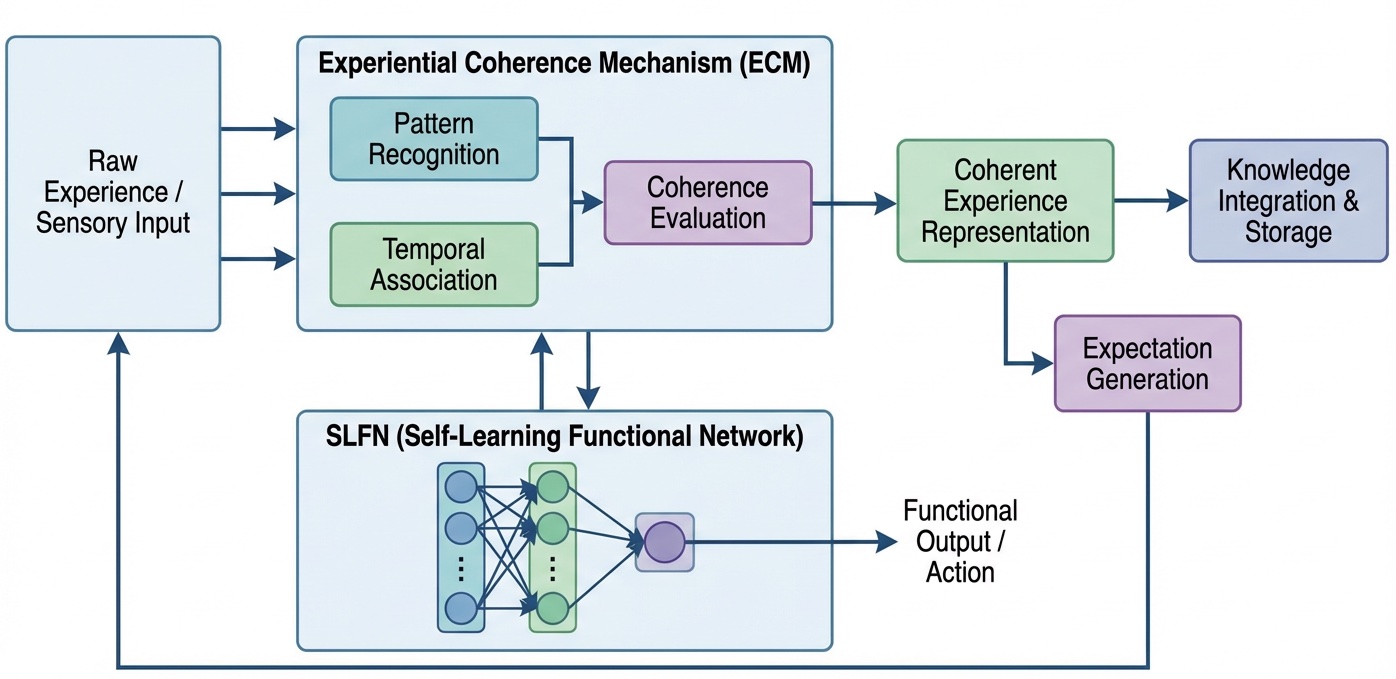
The Entropic Constraint Framework (ECF) studies complex adaptive systems whose own activity changes the conditions under which they will later evolve. A cell, brain, ecosystem, market, spin glass, or artificial agent does not merely move through a fixed space of states. Its trajectory can modify the constraints, attractors, basins, and affordances that shape what becomes possible next.
ECF therefore shifts attention from entropy alone to the relation between trajectory, constraint formation, coherence, and future reach. The aim is not to replace thermodynamics, dynamical systems, information theory, or machine learning, but to provide a common language for systems in which history changes the structure of possibility.
Three Functional Roles
In the current ECF formulation, the key roles are best understood in general, system-level terms rather than as a consciousness-only theory.
Accessible future possibility.
Reach measures how many viable future configurations remain available to a system under its present constraints. A system with high reach can still adapt, explore, and reorganize.
Realized productive structure.
Yield captures what the system can currently stabilize, produce, or exploit. It is the organized output made possible by existing constraints.
Path-dependent constraint inheritance.
Memory is the way past trajectories remain active in the present by modifying constraints, basins, couplings, and affordances. It is not only stored information; it is the historically shaped structure that changes what the system can reach and yield next.
Coherence and Adaptive Balance
ECF treats coherence as a dynamic balance between future reach, current yield, and memory-shaped constraints. Too little constraint produces noise, drift, or fragmentation. Too much constraint produces rigidity, trapping, or loss of future possibility. Adaptive systems often operate in a productive window between these extremes.
Unlike a simple entropy-minimization story, ECF asks whether the system is creating constraints that preserve useful future options while stabilizing meaningful present structure.
Candidate Metrics
The latest ECF version is strongest when it is treated as a measurable research program. Depending on the system, useful quantities may include:
The number, diversity, or value of future states reachable from the present under the current constraint field.
Whether changes in constraints are coupled to the system’s own trajectory or merely random, shuffled, or externally imposed.
The depth, accessibility, and flexibility of attractor basins created by prior dynamics.
In autocatalytic systems, the degree to which reactions collectively sustain and regenerate the conditions for their own continuation.
ECF Compared with Nearby Frameworks
| Aspect | Standard Emphasis | ECF Emphasis |
|---|---|---|
| Thermodynamics | Entropy, free energy, dissipation, steady states. | How dissipation and history create constraints that reshape future possibility. |
| Dynamical systems | State evolution within a defined phase space. | State evolution coupled to modification of the effective phase space, basins, and affordances. |
| Predictive processing / FEP | Prediction error or free-energy minimization. | Constraint-mediated coherence and preservation of adaptive future reach. |
| Machine learning | Optimization of loss over fixed architecture and data distribution. | Architectures that adapt their own constraints, curiosity windows, and reachable repertoires. |
| RAF / autocatalysis | Closed catalytic sets and self-sustaining reaction networks. | Closure as a constraint-forming process that changes the system’s reachable futures. |
Applications
Non-equilibrium physics
ECF can be used to study systems where dissipation, memory, and adaptation reshape the effective landscape: adaptive spin glasses, driven systems, active matter, and systems with path-dependent couplings.
Biology and autocatalytic networks
Living systems maintain themselves by forming constraints that channel matter and energy flows. RAF theory provides one concrete way to formalize closure, while ECF asks how such closure expands or narrows future reach.
Cognition and psychedelics
In cognitive systems, ECF can describe how stable patterns form, become rigid, dissolve, or reorganize. This may be useful for studying learning, trauma, depression, psychedelic therapy, and coherence recovery after perturbation.
Artificial intelligence
ECF suggests AI architectures that do more than minimize a task loss. They may track how internal constraints change future reach, how curiosity windows open or close, and how adaptive coherence emerges across time.
Key Takeaways
- Adaptive systems reshape their own possibility spaces.
- Constraints are productive as well as restrictive.
- Entropy alone is not enough to describe adaptive organization.
- Reach and yield form a trade-off between future possibility and present stabilized structure.
- Coherence is dynamic alignment between trajectory and constraint formation.
- RAF closure, basin restructuring, and constraint alignment are natural test cases for ECF.
- The framework is broad: it can be applied to physics, biology, cognition, and AI without requiring a consciousness-first ontology.
Core Quotes
These compact formulations capture the spirit of ECF and its connection to RAF theory.
Entropy is not the enemy of order; it is the raw horizon from which constraints carve meaningful futures.ECF
Life does not merely resist disorder. It learns how to constrain disorder into possibility.ECF
A system becomes adaptive when its past does not imprison it, but becomes a field through which new futures can be reached.ECF
Complex systems do not simply move through landscapes; they write the landscapes they later inhabit.ECF
RAF shows how chemistry can close upon itself; ECF asks how such closure reshapes the future space of the system.ECF / RAF
Autocatalysis is not only production of molecules. At a deeper level, it is the production of conditions for further production.ECF / RAF
RAF gives us the grammar of autocatalytic closure; ECF gives us the semantics of adaptive possibility.ECF / RAF
An autocatalytic set is not only a structure that makes itself. It is a structure that changes what can happen next.ECF / RAF
Frequently Asked Questions
It can be applied to consciousness, but the current version is broader. ECF is primarily a framework for adaptive constraint formation in complex non-equilibrium systems. Consciousness is one possible domain of application, not the defining starting point.
No. ECF uses thermodynamic and information-theoretic ideas, but argues that entropy-like quantities are incomplete when the system’s own trajectory changes the constraints that define future possibilities.
Classical dynamical systems often assume a fixed phase space and fixed rules. ECF focuses on systems where the trajectory changes the effective constraints, basins, affordances, and reachable futures.
Yes. A simple strategy is to compare three cases: coupled constraint adaptation, shuffled constraint adaptation, and fixed constraints. ECF predicts that trajectory-aligned constraint change should often produce higher future reach and more adaptive coherence than shuffled or rigid alternatives.
RAF theory gives a formal model of self-sustaining autocatalytic closure. ECF adds a broader question: how does such closure alter the system’s future reachable states, robustness, and capacity for novelty?